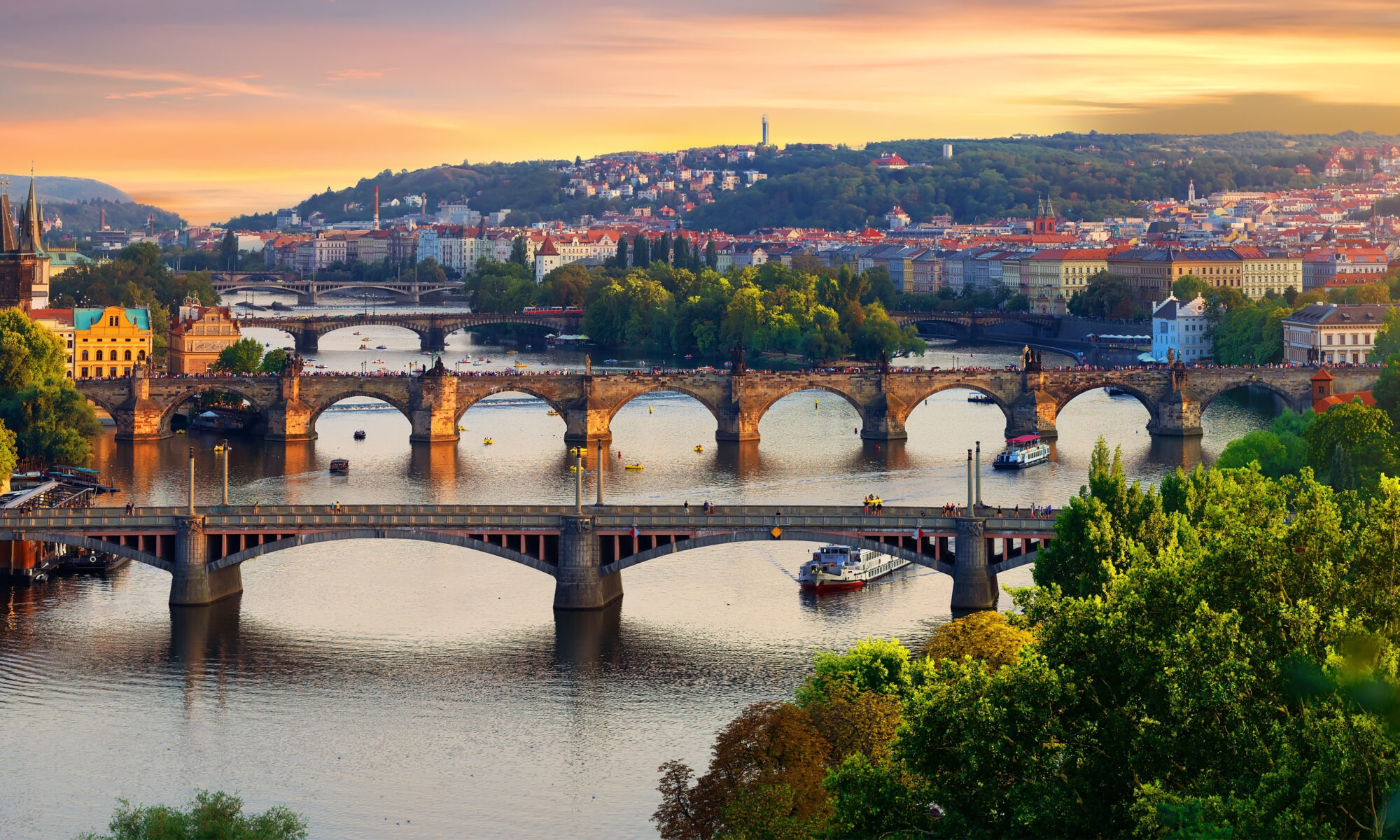
The capital of the Czech Republic is the most valuable urban conservation area in Europe. In 1992 the historical core of the city covering 866 hectares was listed in the UNESCO World Cultural and Natural Heritage Register.
Prague represents a unique collection of historical monuments dominated by Prague Castle which towers high above the city. It merges all artistic and architectonic styles and movements. The historical core of the city is situated on both banks of the Vltava river and consists of six parts - formerly independent urban units unified in the 18th century. They are as follows: Stare Mesto (Old Town), Josefov (the preserved part of the former Jewish Town - today part of the Old Town), Nove Mesto (New Town), Mala Strana (Lesser Town), Hradcany and Vysehrad. Naturally, most of the historical monuments, museums and galleries are concentrated there.
Prague Castle
A castle was built on this site in the 9th century, and a Romanesque palace was erected there in the 12th century. In the 14th century, during the rule of Charles IV, it was rebuilt in the Gothic style. The Royal palace was re-built to the current shape under the Jagellos at the end of the 15th century, and at that time, the builder Benedikt Rejt added the now-famous Vladislav Hall, also in the Gothic style.
The castle was enlarged in the 16th century, especially after a big fire in 1541. The Spanish Hall, in a new part of the castle, was added during the reign of Rudolf II, and it took its final form during the reign of Empress Maria Theresa, under the direction of the architect M. Pacassi. After World War I, the interior and gardens of the castle were renovated by architect J. Plecnik. Today, the Castle is the seat of the President of the Czech Republic, and it serves as the historical and political centre of both the city and state.
St. Vitus, St. Wenceslas and St. Adalbert Cathedrals
The Gothic St. Vitus cathedral is the spiritual symbol of the Czech state. It was founded in the late 9th century by John of Luxembourg and his sons Charles and John Henry. It took nearly six centuries to build. The current cathedral is situated on the site of a 10th-century rotunda. Designed by architects Mathias Arras and Petr Parler, its construction started in 1344. The final stage of construction was completed only in the period between 1873 and 1929. There are underground tombs in the cathedral of Czech kings. Parler also built the St. Wenceslas Chapel which is decorated with frescoes and semi-precious stones. The Czech crown jewels are deposited there, too.
Old Royal Palace
The Old Royal Palace served as the residence of Bohemian princes and kings until the 16th century. It was built upon the relics of a Romanesque palace of Prince Sobeslav. Additional reconstructions in the Gothic and Renaissance styles were initiated by famous Czech kings Premysl Otakar II, Charles IV, Wenceslas IV and Vladislav Jagello. Its most noteworthy part is the Gothic Vladislav Hall - the largest profane hall of medieval Prague (1487 - 1500, Benedikt Rejt) with a remarkable rounded rib vault, today the venue of presidential elections and ceremonial events.
Golden Lane
Small houses built in the gothic fortification, the homes of 16th century castle riflemen and craftsmen. Between 1916 - 1917, Franz Kafka lived in No. 22.
Petrin Lookout Tower and Labyrinth
A reduced copy of the Eiffel Tower (60 m high) built in 1891 on the occasion of the 1891 Jubilee Exhibition. 299 steps lead up to the top platform. A maze of mirrors set up originally for the Jubilee Exhibition (1891) and featuring a diorama of “Battle of the Praguers with the Swedes in 1648 at the Charles Bridge“.
Charles Bridge
Started in 1357 by Master Otto and completed by Petr Parler, this is the oldest bridge in Prague. Its statues and sculptural groups date mostly from the 18th century. The most well-known are the works of Matthias Braun and Ferdinand Maxmilian Brokoff. The bridge is 515 metres long and 10 metres wide.
Old Town Square
Dating from the 12th century, the square has witnessed many a significant event. Beside the Old Town Hall and the Church of Our Lady before Tyn, the square has several other dominants - the baroque St. Nicholas church, the rococo Kinsky palace housing the National Gallery graphic collection, the Stone Bell house - a gothic palace from the 14th century, now the Municipal Gallery concert and exhibition rooms, as well as the Master Jan Hus Memorial sculptured by Ladislav Saloun. The square witnessed the execution of 27 Czech noblemen on 21 June, 1621 - in memory of that event, 27 crosses are marked in the pavement. The Prague meridian can be seen not far from therere.
Wenceslas Square
Prague’s centre of commerce. The upper part of the square is dominated by a statue of the main patron saint of the Czech lands, St. Wenceslas and four other Czech patron saints (St. Prokop, St. Adalbert, St. Ludmila and St. Agnes) by Josef Vaclav Myslbek. Erected in 1912.
National Theatre
A neo-Renaissance building of 1868-81, built to plans of J. Zitek. A fire destroyed much of the building in its first year of existence. It was rebuilt by architect Josef Schulz in 1883 and underwent a thorough renovation a hundred years later. The authors of both exterior and interior decorations are artists of the so-called National Theatre generation: M. Ales, F. Zenisek, V. Hynais, J. V. Myslbek, and others. The National Theatre is a major Czech stage and its repertoire includes drama, opera and ballet.
Vysehrad
The ancient seat of the Premyslide princes built on a rock over the river Vltava. The oldest building there is the rotunda of St. Martin. The main landmark of Vysehrad is the St. Peter and Paul cathedral. In its vicinity, there is a residence for canons, casemates, a park, and a cemetery called Slavin with tombs of famous personalities of Czech culture. The Southern part of the fortifications offers a beautiful view of Prague. Vysehrad is open to public round the clock.
All important information about Prague such as food&drink, places, events, etc. can be found at www.prague.eu.